
Created December 2025, Reading time: approx. 2-3 minutes
Many people believe that the costing process in construction consists of one preliminary estimate at the beginning and one final estimate when the project is completed. In practice, the costing process is much more dynamic. Different estimates are used at different stages to support decisions, reduce risk and ensure financial control.
This article provides a complete overview of which calculations normally lie between pre-calculation and post-calculation , and how they are used in practice.
This article is part of the main guide: Costing in construction - a complete guide to profitable projects
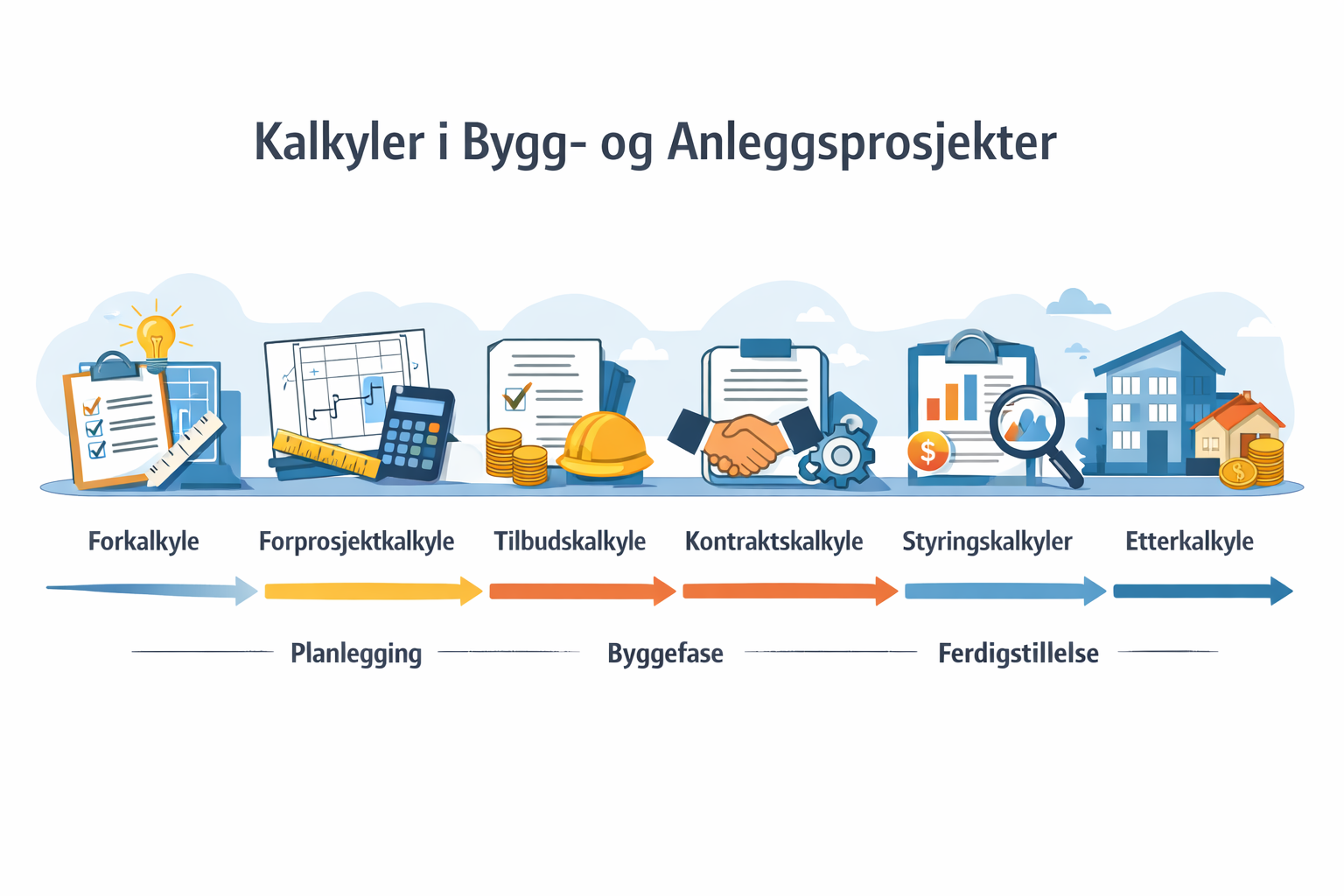
Overview of calculations throughout the project lifecycle
A simplified sequence might look like this:
Precalculate
Preliminary project estimate (concept/framework estimate)
Detailed calculation / quotation calculation
Contract calculation
Management estimate (project budget)
Revised calculations / forecasts
Post-calculation
Not all projects use all of these terms, but the functions are in practice the same.
1. Preliminary project estimate / framework estimate
When the project goes from idea to preliminary project, a more precise estimate is often made than the preliminary estimate. This is often called:
Preliminary project estimate
Framework calculation
Concept calculation
Here the space program, technical principles and main solutions are clarified. The quantities are still rough, but far better than in the preliminary calculation. This calculation is often used for:
Final investment decision
Determining the cost limit
Further project management
2. Detailed estimate / quotation estimate
This is the most detailed estimate before construction begins. It is prepared based on:
Finished drawings
Descriptions (NS 3420)
Quantity lists
Prices obtained from suppliers and UE
The detailed cost estimate is used for:
Bid submission
Internal profitability assessment
Comparison with framework budget
For contractors, this is often the most important calculation in the project.
3. Contract calculation
Once a contract has been entered into, a contract estimate is established based on:
Agreed contract amount
Clarified reservations
Changes before start-up
This serves as a reference for further financial follow-up.
4. Management estimate (project budget)
The management estimate is the contractor's or client's internal budget . It is adjusted:
Planned progress
Resource usage
Risk assessments
Experience figures
This is the calculation the project manager uses to:
Cost management
Forecasts
Deviation analysis
5. Revised calculations and forecasts
During the project, the estimate will be updated based on:
Change worker
Market changes
Actual progress
These are often called:
Revised calculation
Forecast
Expected Final Cost (EAC)
They provide an ongoing overview of where the project is heading financially.
6. Post-calculation
When the project is completed, actual costs are compiled in the final cost estimate. This is used to:
Evaluation of the project's finances
Comparison with previous calculations
Improving future estimates
Why so many calculations?
The reason why construction projects use multiple calculations is:
High uncertainty in the early phase
Long projects with many changes
Major financial consequences of small deviations
More calculations lead to better management, not more bureaucracy.
Yes – there are several important calculations between pre-calculation and post-calculation . These act as bridges between idea and finished project, ensuring that finances are closely monitored throughout the entire lifecycle.
Do you need help with calculations?
We offer a solution that streamlines and simplifies the calculation process in construction projects. Book a free demo or get a no-obligation quote:
Read more about our calculation tool here!