
What is BIM? A simple explanation for construction and civil engineering
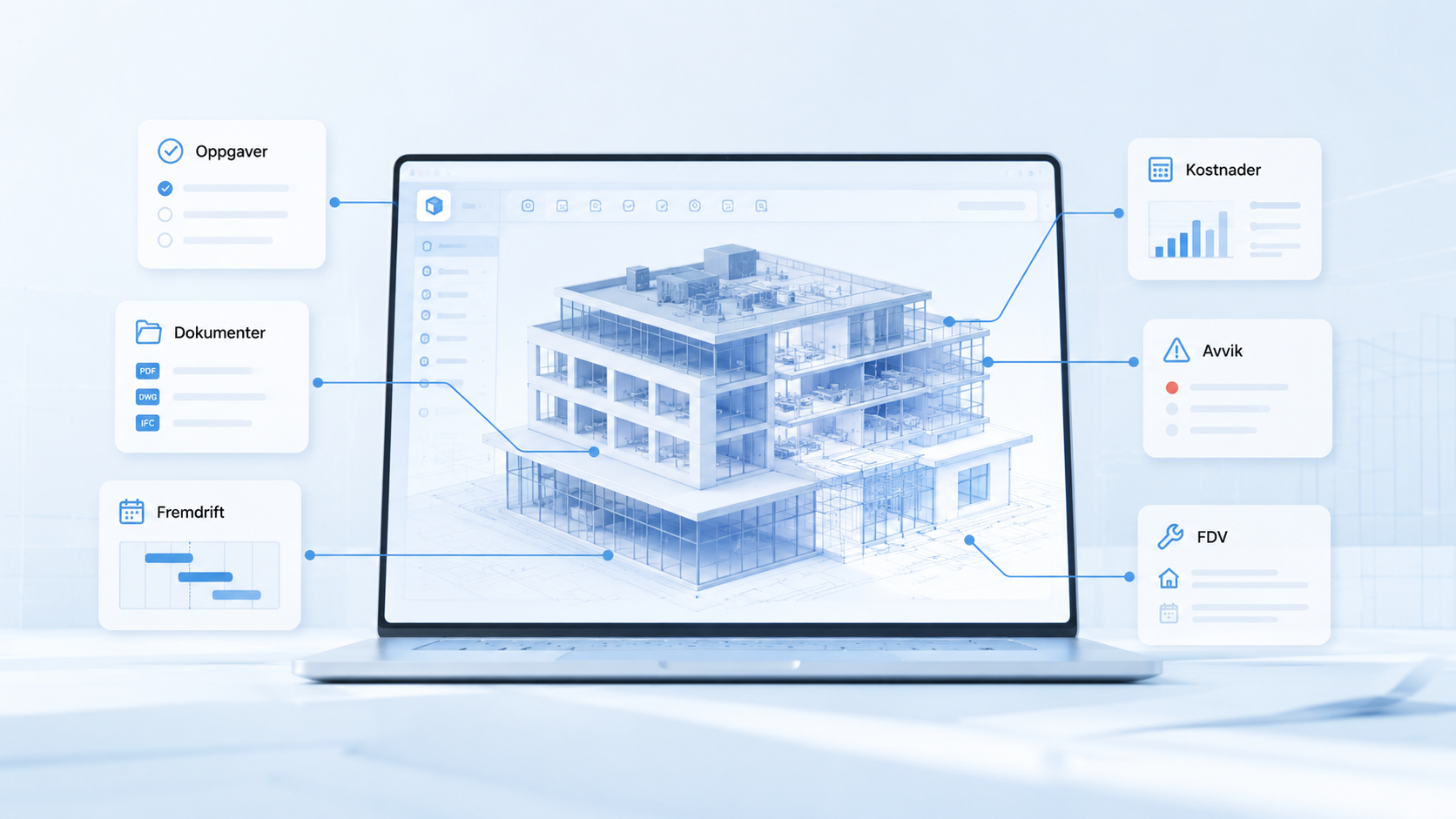
BIM is not just about modeling a building in 3D. It is about structuring the information around how the building will be planned, built, operated and understood.
In construction projects, there are many disciplines, actors, documents, drawings, decisions and changes that need to be interconnected. BIM makes it possible to collect more of this information in one common digital structure.
Where traditional drawings show what something looks like, BIM can also say something about what the building parts consist of, what function they have, what requirements apply, and how they relate to the rest of the project.
What does BIM mean?
BIM stands for Building Information Modeling .
In Norwegian, terms such as building information modeling or digital building model are often used. Many people associate BIM with 3D models, but BIM is more than just a visual model of the building.
BIM is a method for organizing and collecting information about a building throughout the project's lifecycle.
Instead of drawing lines, surfaces and symbols as in traditional CAD, a BIM model consists of intelligent objects.
For example, a wall is not just a line in a drawing. It can contain information about:
materials
thickness
fire class
sound requirements
costs
supplier
FDV documentation
progress
status
The same can apply to doors, windows, decks, technical systems and other building parts.
In this way, the BIM model becomes more than a drawing. It becomes a structured information model for the project.
Why is BIM used in construction projects?
BIM is used to create better overview, better collaboration and better decisions in construction projects.
When multiple disciplines work on the same project, misunderstandings, errors and collisions can easily arise. Architects, consulting engineers, contractors and subcontractors often work on different parts of the same building.
BIM makes it easier to see how these parts are connected.
BIM can be used, among other things, to:
improve coordination between disciplines
reduce errors and collisions
visualize the building before it is built
provide a better overview of the project
structuring project information
streamline planning and production
provide a better basis for decisions
For example, a BIM model can be used to detect conflicts between ventilation, piping, and load-bearing systems before work begins on site, saving time, cost, and unnecessary rework.
BIM is more than 3D modeling
In many projects, BIM is used primarily in the design phase.
The model is often used for:
engineering
coordination
visualization
collision control
quantity withdrawal
These are important applications. But the challenge often arises when the project moves from planning to actual production.
Then much of the work still happens in separate systems.
Tasks may be in one system. Documents may be in another. Deviations are handled in PDFs or forms. Hours are recorded in separate solutions. Communication occurs through email, phone, meetings and chat.
The result is that the BIM model can be left a little behind the actual project work.
The model shows the building, but not necessarily everything that happens around the building.
When BIM is not connected to the project work
Imagine that a deviation occurs on an exterior wall.
The project manager may need to:
find the right drawing in one system
search for images in another system
find the task in a third system
check email for history
contact the correct contractor manually
document the discrepancy elsewhere
Although the building is modeled in BIM, the project work itself is still fragmented.
The information exists, but it is scattered.
This makes it more difficult to get an overview of what has happened, who is responsible, which documents apply, and what the status actually is.
BIM is then used to look at the building, but not necessarily to run the project.
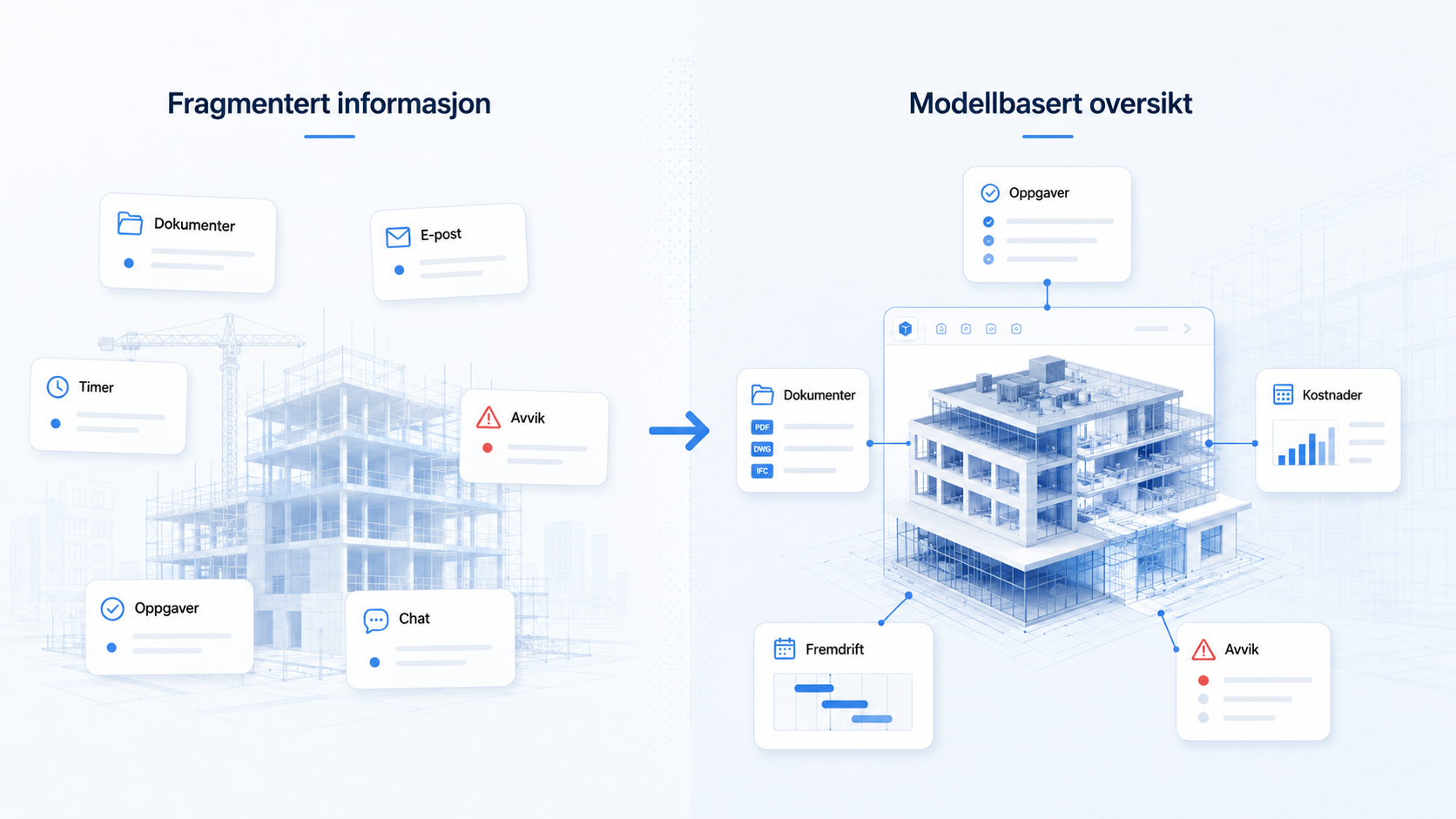
From fragmented project information to model-based overview: When tasks, documents, deviations, progress and costs are connected to the BIM model, the model becomes a more active part of project management.
Next step: model-based project management
The next step is to connect the BIM model more closely to the actual work in the project.
This can be called model-based project management.
Model-based project management is about linking tasks, documentation, deviations, progress, costs and history directly to the objects in the model.
Then the model doesn't just become something you look at. It becomes an active work surface.
If you click on a wall in the model, you should be able to see the information that belongs to that particular part of the building.
For example:
tasks
deviation
documents
photos
progress
costs
responsible
history
status
That way, it becomes easier to understand what applies, what has been done, what remains, and what decisions have been made.
From model to work surface
When project information is linked directly to the building parts in the model, it becomes easier to work in a more structured way.
Instead of searching through folders, emails, spreadsheets and separate systems, the project team can start from the building itself.
It provides a more visual and practical way of working.
For the project manager, it can mean a better overview of status and responsibilities. For the implementer, it can mean easier access to the right information. For management, it can mean better control over progress, costs and documentation.
The point is not just to have a digital model.
The point is to use the model as an input to the actual work of the project.
How buildit works with BIM and model-based project management
At buildit, we are working to make the BIM model a more active part of project management.
The goal is to enable project work, documentation, progress and costs to be more closely linked to the building's digital model.
With modules like my project , my planner and my calc project information can be collected and structured across the project.
It can make it easier to connect:
tasks
documentation
progress
calculation
costs
history
status
When the information is better connected, it also becomes easier to understand the project as a whole.
This allows the team to work more directly in the building, not just next to it.
Why this is important for the construction industry
Construction projects are becoming increasingly complex. There are more requirements, more actors, more documentation and higher expectations for control.
At the same time, much of the project information is still scattered between different systems and working methods.
This makes it more difficult to keep track of the project, especially as it grows.
BIM can contribute to better structure, but the value becomes greater when the model is connected to what actually happens in the project.
When tasks, documents, progress and costs are linked to the model, it becomes easier to find the right information, track status and make better decisions.
The future of BIM
BIM is evolving from being a design tool to becoming a more operational part of the construction project.
Future construction projects will increasingly work directly within the model, not just alongside it.
When project data is continuously connected to the model, it can eventually develop into something more than a planned model of the building.
It can become a digital representation of the building as it is actually built, modified, documented and operated.
This is what many refer to as a digital twin.
A digital twin is not just about how the building looks. It is about collecting up-to-date information about the building, so that project teams, owners and operators alike gain better insight throughout its entire lifecycle.
In summary
BIM is more than 3D modeling.
It is a method for collecting, structuring and using information about a building throughout the project's life cycle.
BIM can contribute to better coordination, fewer errors, better visualization and more structured project information. But the greatest value arises when the model is more closely connected to the actual work on the project.
When tasks, documentation, progress, costs and history are linked directly to the building parts, the model becomes more than a drawing.
It becomes a work surface.
And this is where model-based project management becomes an important next step for the construction industry.
Would you like to see how BIM can be more closely connected to project management?
See how buildit can collect project information, progress, documentation and costs more structured around the project's digital model.
