
From IFC import to model-based calculation
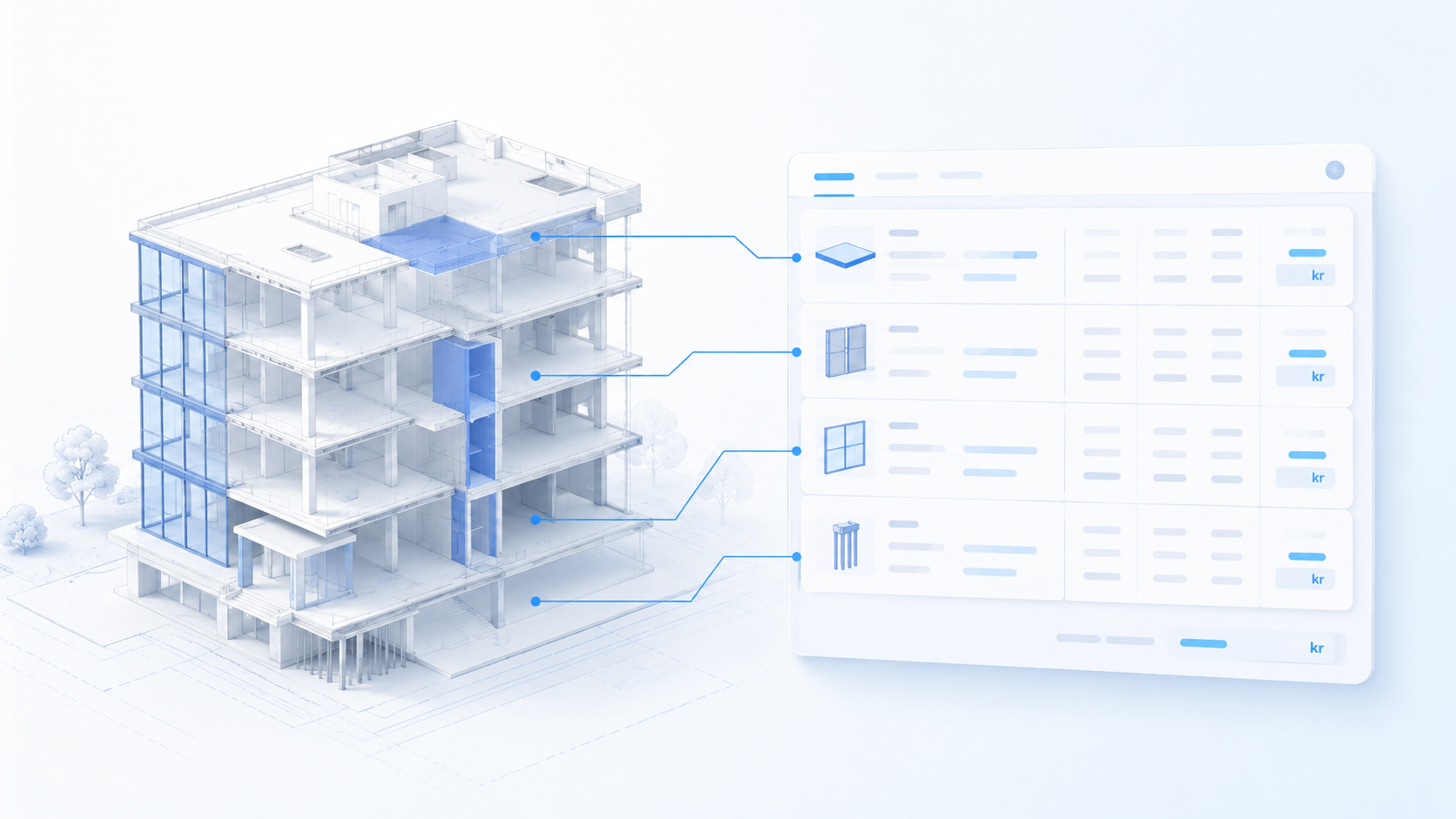
BIM and IFC have long been about quantity take-off
For many years, BIM and IFC have been closely linked to automated quantity takeoff and calculation.
The idea has been simple:
import the IFC model
retrieve quantities
generate the calculation automatically
For the construction industry, this has been an attractive idea. If the model already contains information about the building, why not use it directly in the calculation work?
Many calculation tools in Norway and internationally therefore offer various forms of IFC import and BIM-based workflows.
But in practice, IFC import alone is not always enough.
For a broader review of costing, methods, costs and digital tools, you can read our complete guide to costing in construction.
Would you like to see how BIM and IFC can be used in calculation work?
In mycalc, we work with model-linked calculation, where calculation, quantities and BIM model can be more closely linked.
See mycalc →The challenge with IFC-based calculations
The quality of IFC-based calculations can vary greatly from project to project.
The reason is often that BIM models are built and structured differently:
objects are structured differently
properties are named in different ways
quantities may be incomplete
models have different levels of detail
IFC data varies between disciplines and suppliers
The result is that automatic quantity take-offs often require manual control, assessment and quality assurance before the calculation can be used further.
Therefore, modern BIM calculation is not just about extracting quantities automatically.
It is also about how the estimate is connected to the actual structure of the project.
From IFC import to model-based calculation
To understand the difference, it is useful to distinguish between IFC import as a quantity basis and model-based calculation as a workflow.
Briefly explained
IFC import is often about retrieving quantities from the BIM model. Model-based calculation is about connecting the calculation to the actual building parts in the model, so that the information can be used further in the project.
Instead of seeing IFC solely as a format for quantity takeovers, the construction industry is gradually moving towards more model-based workflows.
This means that the BIM model is not only used for visualization or calculation in the early phase. It can also become a structure for the information that follows the project further – from calculation to implementation and documentation.
For the calculation work, this means that the calculation no longer needs to be detached from the model. It can be linked to the same objects that are later used in follow-up, progress and documentation.
In Buildit, my calc is developed with a focus on model-linked calculation, where calculation objects can be connected directly to the building parts in the model via the IFC structure.
It makes it possible to connect:
calculation
quantities
building parts
documentation
progress
hours
costs
photos
history
...directly to the objects in the building.
IFC GlobalId as connection point
Each building part in an IFC model has a unique IFC GlobalId.
This acts as an identity for the object throughout the project. When calculation and project data are linked to the IFC GlobalId, information can be traced back to the correct building part in the model.
For example, an exterior wall may contain:
calculation lines
material information
documentation
hours
progress
deviation
construction site photos
responsible contractor
...collected on the same object in the model.
In this way, the model does not just become a basis for quantity take-off. It also becomes a place where information about the building component can be collected and used further in the project.
From calculation to project context
Traditional calculation tools are often built around:
calculation lines
folders
reports
price banks
This is still important in the calculation work.
Model-based calculation is still about giving the calculation more context.
When project data is linked to the building's structure, it becomes easier to:
understand what the costs are
follow progress per building section
see the connection between economics and production
find documentation directly on the object
analyze profitability in context
This provides a more operational workflow, where the estimate is not only used in the quotation phase, but can also follow the project further.
Part of the digital twin
When calculations, progress, documentation and history are connected to the BIM model, the model can become more than a visual 3D model.
It can function as a common information base for the project.
This is the same direction that is often referred to as digital twin, where the model not only shows what the building looks like, but also collects data about the work, costs, progress, and documentation related to the building.
For contractors and project organizations, this means that BIM can be used as a basis for more than design and visualization.
It can also become part of daily project implementation.
Who is model-based calculation relevant for?
Model-linked calculation is particularly relevant for contractors and project organizations working on larger or more complex projects, where the BIM model is actively used in planning and implementation.
It can also be useful when multiple disciplines, suppliers and actors are working on the same project, and there is a need for better traceability between calculations, quantities, progress and documentation.
Model-linked calculation does not need to replace traditional calculation, but can provide better coherence between the calculation and the rest of the project work.
Model-linked calculation in my calc
At Buildit, we work with my calc as part of a model-based project platform.
The calculation can be linked directly to objects in the BIM model and viewed in the context of:
tasks
progress
documentation
hours
photos
project communication
…across modules such as:
The goal is to make BIM more operational and accessible for daily project implementation.
Where IFC import has traditionally been about extracting quantities, model-linked calculation is about linking the calculation more closely to the building, the project, and the information that is created along the way.
Should you consider different solutions? Also read our comparison of calculation tools for construction and civil engineering.
Would you like to see model-based calculation in practice?
See how mycalc can connect calculation, quantities and BIM model more closely together.
