
Liability law in construction
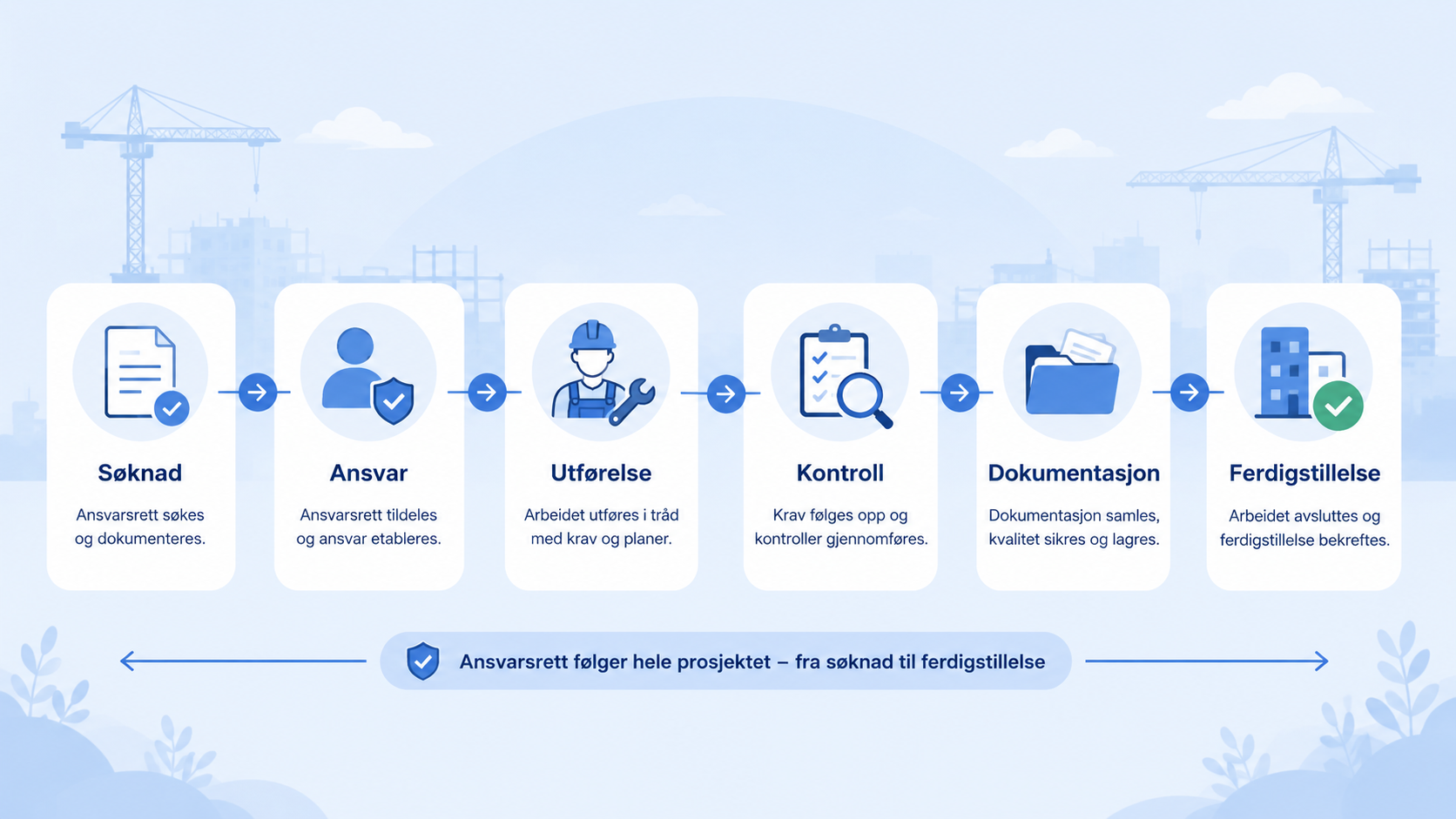
Liability law is an important part of many construction cases.
Nevertheless, liability law is often seen as something that is primarily about the building application.
A company declares liability.
The municipality receives the documentation.
The project can proceed.
But in practice, accountability is about more than filling out a form. It's about who is responsible for which parts of the project, how the work should be documented, and how quality should be ensured along the way.
When responsibilities are unclear, it can lead to misunderstandings, lack of documentation, errors in execution, and challenges at completion.
Therefore, liability law should not be understood simply as a formality in the application process.
It should also be seen as an important part of project management.
What is liability law?
Liability rights mean that a company assumes responsibility for specific tasks in a construction project.
This may, for example, apply to responsibility for application, design, execution or inspection.
The right of responsibility should show who is responsible for what in the construction matter, and it should contribute to ensuring that the measure is implemented in line with the requirements of the Planning and Building Act, the Construction Regulations and the Building Technical Regulations.
The company must declare liability before the work begins. Liability occurs by sending a signed declaration to the municipality. The declaration is sent either together with the application or at the latest before the company starts its work.
The most important roles in liability law
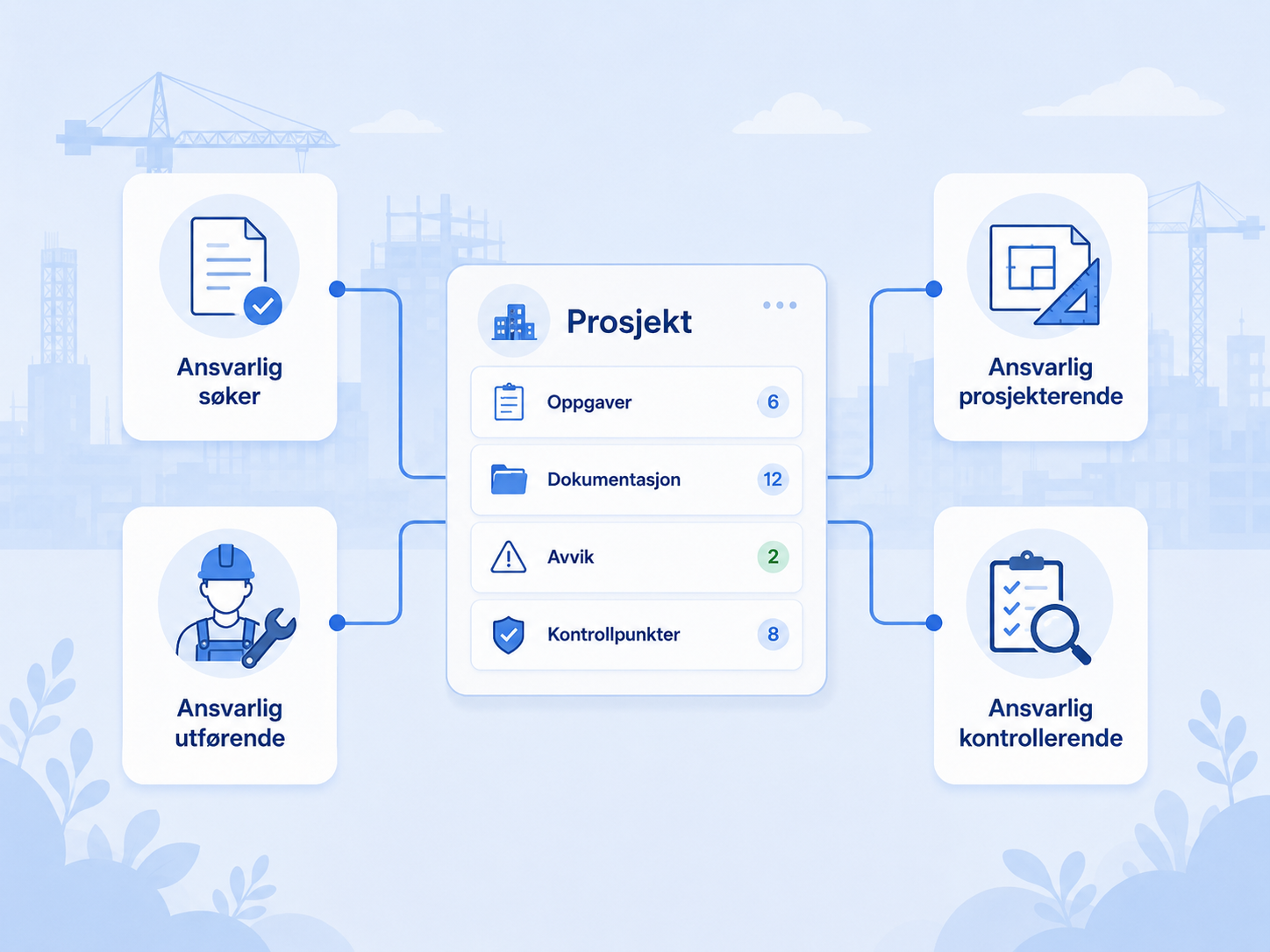
In construction cases involving liability law, there are several roles that may be involved.
The most common are:
responsible applicant
responsible designer
responsible executive
responsible controlling
The responsible applicant has a coordinating role in the construction process. This includes ensuring that the areas of responsibility are covered and obtaining the necessary documentation from the other responsible entities.
The responsible designer is responsible for the design within his area of responsibility. The design must be quality assured and documented, and it must provide a sufficient basis for the execution.
The responsible contractor is responsible for ensuring that the work is carried out in accordance with the design, permits and relevant requirements.
Responsible inspectors are used where there is a requirement for independent control. The inspection company must verify that the design and construction comply with the regulations and the building permit.
Liability law is about interfaces
One of the most important practical challenges with liability law is interfaces.
In a construction project, it is rarely one company that does everything.
Several disciplines and actors may be responsible for different parts of the project. In that case, it must be clear:
who designs what
who performs what
who controls what
who documents what
who follows up on deviations
who provides the basis for completion
If the interfaces are unclear, important tasks can fall between multiple actors.
Everyone thinks someone else is responsible.
And only later do you discover that documentation is missing, checks have not been carried out, or that a clarification was never followed up on.
Liability and documentation
Liability law is also about documentation.
Companies that declare responsibility must be able to document that the tasks within their area of responsibility have been carried out.
This applies, among other things:
quality assurance
declarations of conformity
control statements
deviations and closure of deviations
documentation of work performed
basis for completion certificate
The responsible company must retain documentation of the fulfillment of its liability rights for 5 years after the certificate of completion has been issued.
Therefore, it is important that documentation is not only collected at the very end, but is structured throughout the project.
Why liability law is important for project management
Responsibility law affects project management because it says something about who is responsible for different parts of the work.
When responsibilities are clear, it becomes easier to follow up:
tasks
deadlines
documentation
deviation
changes
checkpoints
completion
When responsibilities are unclear, the project becomes more difficult to manage.
Then the project manager can spend a lot of time figuring out who is actually going to respond, who is going to deliver documentation, and who is responsible for the next step.
For a broader review of project management in construction projects, you can read our complete guide to project management in construction.
Typical challenges with liability law in practice
In practice, many problems arise when responsibilities are not clearly defined or followed up.
Typical challenges are:
unclear areas of responsibility between disciplines
lack of consistency between application, design and execution
documentation collected too late
deviations that are not linked to the responsible company
changes that are not followed up against responsibility
lack of clarity about who is supposed to deliver what
challenges with the completion certificate because documentation is missing
Many of these problems are not just about regulations.
They are about structure, communication and project follow-up.
Would you like to gain better control over responsibility, documentation and follow-up?
See how Buildit collects tasks, deviations, documentation and project follow-up in one project area.
Liability, deviations and changes
Deviations and changes should always be seen in the context of responsibility.
If something deviates from the design, requirements or permits, it must be clear:
what the deviation concerns
Who is responsible for follow-up?
what consequences it has
what documentation is required
when the deviation is closed
The same applies to changes.
When a solution is changed along the way, it should be clear who designed the change, who approved it, who will carry it out, and how it will be documented.
You can read more about this in our articles about deviations in construction projects and change management in construction.
Liability upon completion
Liability law becomes extra important towards the end of the project.
Before the completion certificate is issued, the necessary documentation must be in place.
This may include declarations of conformity, control declarations, final documentation and other documentation that shows that the work has been carried out in accordance with the requirements.
If documentation is missing, completion may be delayed.
Therefore, responsibilities and documentation requirements should be followed up throughout the project, not just when the project is nearing its end.
How digital project management can help
Digital project management systems can make it easier to follow up on responsibilities in practice.
When tasks, documentation, deviations, changes and deadlines are collected in one system, it becomes clearer who is responsible for what.
It makes it easier to:
assign tasks to the right person or company
link documentation to the correct case
follow up on deviations and changes
ensure history and traceability
see what is missing before completion
document work along the way
The goal is not to replace the regulations.
The goal is to make it easier to follow up on responsibilities in everyday life.
How buildit supports accountability tracking
buildit helps project teams collect project information, documentation and follow-up in one place.
Instead of responsibilities, clarifications and documentation being spread across emails, folders and separate systems, the project team can work in a more structured way with:
tasks
deviation
changes
documentation
progress
history
communication
This provides a better overview of who is responsible, what has been done, what remains to be done and what documentation is required.
Liability law is about more than an application
Liability law is a formal part of the construction case.
But in practice it affects the entire project implementation.
It is about roles, interfaces, documentation, quality assurance and follow-up.
When responsibility is clear, the project becomes easier to manage.
When responsibility is unclear, the risk of errors, deficiencies and delays increases.
Therefore, liability law should not just be treated as a form at the start of the project.
It should be followed up throughout the entire construction process.
Do you want to gather responsibility and project follow-up in one place?
Book a demo and see how build makes it easier to follow up on tasks, deviations, documentation and history in construction projects.
