

Construction projects rarely develop exactly as planned. Changes to construction projects therefore often occur along the way, either as a result of new requirements from the client, changes in design or unforeseen conditions on the construction site.
Changes are therefore a natural part of construction projects.
The challenge arises when changes are not handled in a structured manner. Small adjustments can then develop into delays, conflicts or loss of profitability.
Good change management in construction is therefore not just about documentation. It is about ensuring control over progress, finances and responsibility when the project changes along the way.
This article explains what change management involves, why it is important in construction projects, and how changes, additions, and deductions can be handled in a structured manner.
What is change management in construction projects?
Change management in construction is about identifying, assessing, documenting and following up on changes in a project.
A change can occur when:
The client wants adjustments to the project.
the design changes
unforeseen circumstances arise on the construction site
technical solutions must be adapted along the way
coordination between disciplines requires adjustments
When such situations arise, the change must be assessed technically, economically and in terms of progress.
The goal is to ensure that all changes are handled in a controlled manner – so that the project can still be implemented within the agreed framework.
In many projects, such changes are formalized as a change order, which describes what is to be done and what consequences it has for time and cost.
What are additions and deductions?
In construction projects, the terms addition and subtraction are often used in connection with changes.
Add-ons occur when the project requires work that was not included in the original contract.
This could be, for example:
additional work ordered by the builder
new technical solutions
adjustments that occur during the project
Deductions occur when work is removed or reduced from what was originally agreed upon.
This can happen if:
parts of the project are deleted
solutions are simplified
alternative solutions are chosen
Additions and deductions affect both the project's finances and progress, and must therefore be handled clearly and documented along the way.
Typical reasons for changes in construction projects
Changes in construction projects can occur for many reasons. Some of the most common are:
changes from the builder
deficiencies or errors in design
unforeseen ground conditions
new requirements from authorities
coordination between different disciplines
technical adjustments during the project
In many cases, changes occur because the project evolves and new conditions become visible as the work progresses.
Changes are therefore not necessarily a sign of poor planning. What is crucial is how the changes are handled when they occur.
How changes affect the project
Even small changes can have consequences for the project if they are not handled systematically.
Changes may affect:
progress of the project
project costs
coordination between disciplines
responsibility between actors
When changes are not documented or clarified clearly, it can lead to disagreements between project stakeholders.
Therefore, structured change management is an important part of good project management in construction.
Without structured handling of additions and deductions, the consequences can be delays, increased costs and unclear division of responsibilities.
👉 Read more in our complete guide to project management in construction.
How changes should be handled in construction projects
In practice, change management in construction projects often follows a structured process.
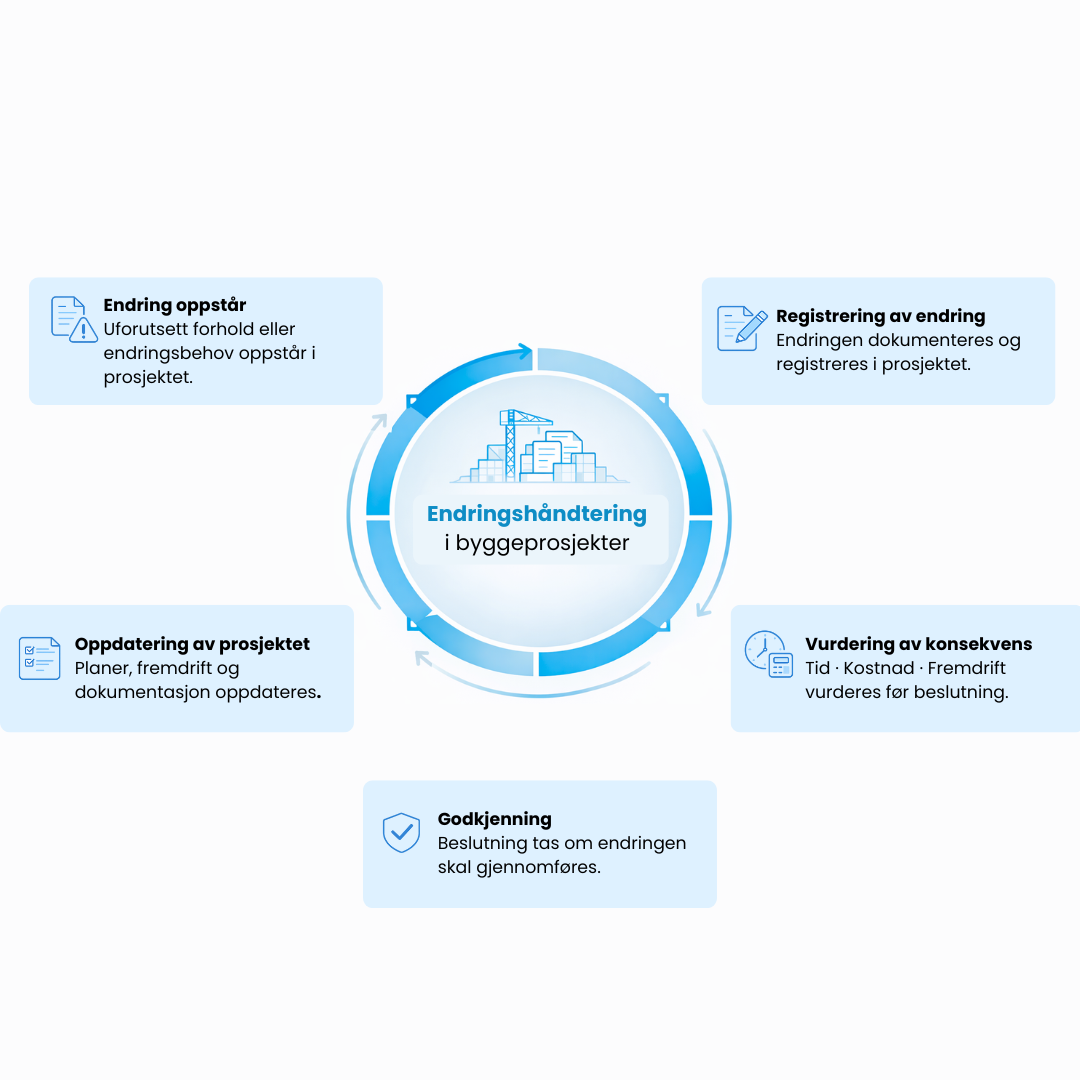
Model for change management in construction projects – from identifying change to updating the project.
1. Identify the change
First, the project must identify what has actually changed.
This could be:
new requirements
adjustments in solutions
unforeseen circumstances
The earlier the change is identified, the easier it is to handle.
2. Consider consequences
When a change occurs, the project must consider what consequences it may have.
This applies in particular to:
costs
progress
technical solutions
coordination between disciplines
A good assessment makes it possible to make the right decisions before implementing the change.
3. Document the change
Changes should be clearly documented in the project.
This includes, among other things:
what has changed
why the change occurs
what consequences the change has
who approved the change
Documentation is important both for project management and to avoid conflicts later in the project.
In addition, notification of changes is important to ensure that all parties are informed and in agreement before the work is carried out.
4. Approve the change
Changes must be clarified between relevant stakeholders in the project.
This could be:
builder
contractor
project manager
projecting
A clear approval process ensures that all parties have a common understanding of what has been agreed. Clear roles and responsibilities also make it easier to handle changes in a structured way.
In many cases, this happens through an approved change order, which forms the basis for further work.
👉 Read more in the article about roles and responsibilities in construction projects.
5. Follow up on the change in the project
Once the change has been approved, it must also be followed up in project management.
This may involve updating:
progress schedule
project economics
documentation
coordination between disciplines
The change will then become part of the project's further implementation.
The connection between changes, risk and deviations
Changes in construction projects are often closely linked to both risk and deviations.
When risks are not identified or followed up early, it can lead to the need for changes in the project.
Similarly, unforeseen events can lead to deviations that in turn require adjustments to the project.
👉 Read more about how risk is managed in construction projects in our article about risk and uncertainty in construction projects.
If changes are not handled in a structured manner, the consequences can also be deviations in the project.
👉 Read more about how deviations should be handled in the article about deviation handling in construction.
Common mistakes in change management
Although most construction projects deal with changes along the way, there are some challenges that remain.
Common errors include:
changes are handled verbally
changes are documented too late
consequences for progress are not considered
Additions and deductions are only clarified at the final settlement.
Responsibility for follow-up is unclear
When changes are not handled systematically, it can lead to conflicts, delays and financial challenges in the project.
In summary
Changes are a natural part of construction projects. The difference lies in how they are handled.
When changes are identified early, thoroughly assessed, and clearly documented, the project can handle additions and subtractions in a controlled manner.
Good change management makes it possible to ensure progress, finances and good cooperation between the players in the project.
Many construction companies therefore choose to collect changes, deviations, documentation and progress in one project management system – so that change orders, additions and deductions can be registered, assessed and followed up throughout the entire project.
👉 See how a project management system for construction can contribute to better control of changes, additions and deductions in the project.
