
Project types in construction – turnkey, main and shared contracts explained
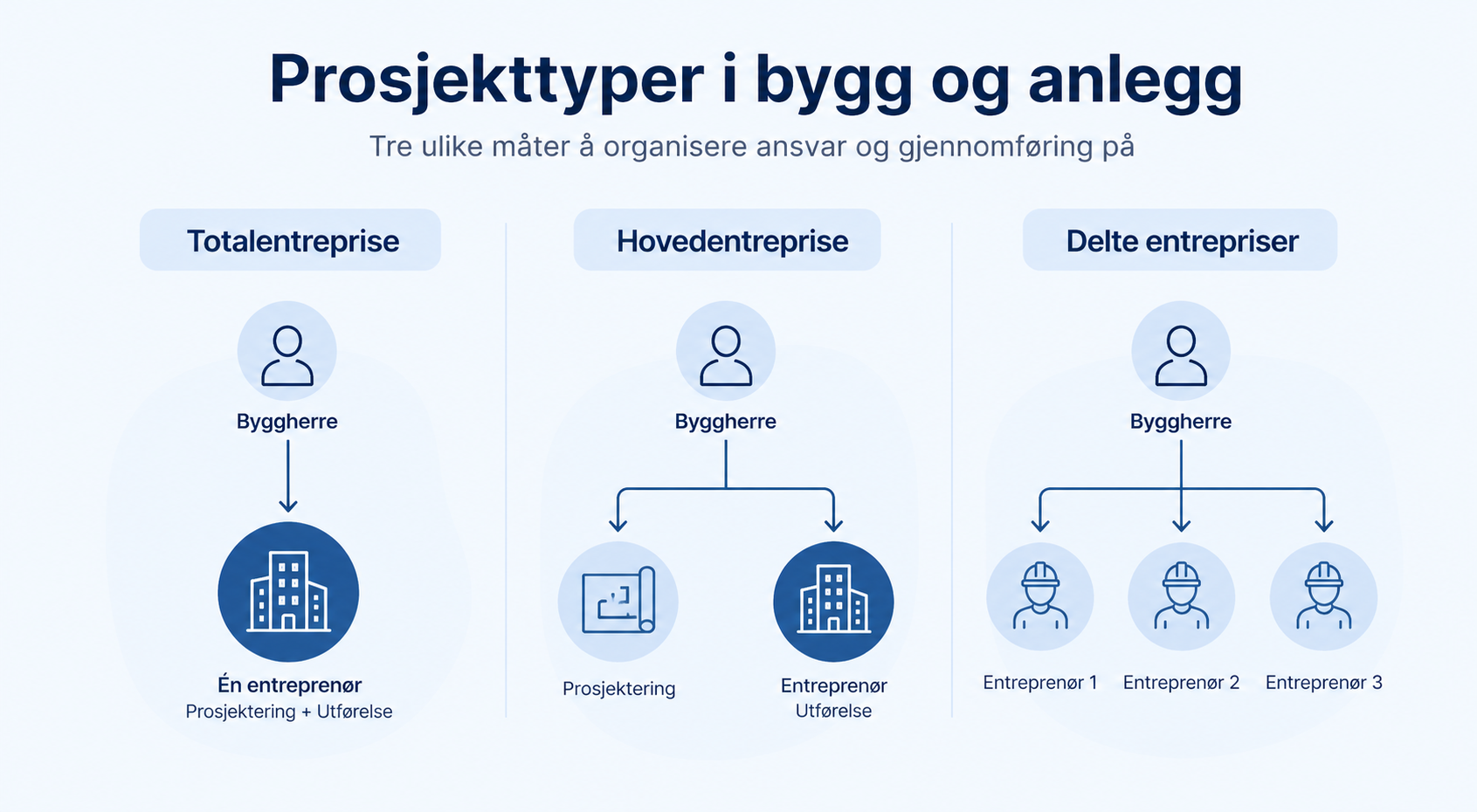
How the project's organization affects responsibility, risk and project management in practice
In construction projects, it's not just what you build that determines the outcome – but how the project is organized.
For builders and project managers, choosing a project type is one of the most important steps you take early in the project.
The project type determines who is responsible, how risk is distributed – and how demanding project management will be in practice.
The wrong choice often leads to unclear responsibilities, conflicts and poor progress. The right choice provides clear roles, better flow and more predictable execution.
👉 Read more in our complete guide to project management in construction.
What is a project type?
A project type describes how a construction project is organized – specifically how responsibilities and tasks are distributed between the client, contractors and other stakeholders.
It determines, among other things:
who designs
who performs
who bears the risk
how communication and decisions are made
Project type is therefore not just a contract form – it governs how the project is actually implemented.
The most common project types in construction
In practice, a few main models are used in most construction projects. They differ primarily in how responsibility, risk and coordination are distributed between the client and contractors.
| Project type | Who is responsible? | Benefits | Challenges |
|---|---|---|---|
| Turnkey contract | The contractor is responsible for both design and execution. |
Clear responsibility Less coordination for the client Simpler decision lines |
Less control over details Changes can be costly |
| Main contract |
The client designs Contractor performs |
More control over solutions Clear distinction between design and execution |
Greater responsibility for the developer More need for coordination |
| Shared contracts | The client enters into contracts with several contractors and coordinates them themselves. |
Flexibility Opportunity for cost savings |
High complexity Risk of misunderstandings Demanding project management |
The table provides a simplified overview, but in practice the differences are more nuanced. Below we take a closer look at how each project type works in practice – and what it means for responsibility, risk and project management.
How to choose the right project type
There is no one solution that fits all projects – but the choice should always be conscious.
Here are some key considerations:
Project complexity
The more complex the project, the more important clear responsibilities and fewer interfaces are.
Expertise of the builder
Do you have the capacity and experience to manage and coordinate multiple contractors?
Risk and uncertainty
How do you want to distribute risk between the parties?
👉 Read more about how risk and uncertainty affect construction projects.
A simple rule of thumb
If you are unsure, this might be a good starting point:
Choose turnkey contracting if you want less responsibility and fewer interfaces
Choose main contractor if you want control over the design
Choose shared contracts if you have the expertise and capacity to coordinate yourself.
Consequences for project management
Project type affects how demanding project management becomes in practice.
Among other things:
how progress is planned
how changes are handled
how communication works
how responsibility is followed up
👉 Read more: Change management in construction projects
For example:
In turnkey contracts, a lot of responsibility lies with the contractor.
In shared contracts, the client must take a more active role
👉 Read more about how project management works in practice in construction projects.
The project type also affects how requirements and regulations are followed up in the project.
Common challenges with the wrong project type
Many problems in construction projects arise before the project starts – when the project type is not adapted to the project.
Typical challenges:
The client has more responsibility than planned.
contractor is held liable without sufficient basis
design and execution are poorly coordinated
changes become more difficult to handle
For example:
In shared contracts, lack of coordination can lead to delays between disciplines.
In turnkey contracts, unclear requirements can lead to disagreements about what is actually included.
The challenges are rarely about the execution alone – but about how the project is organized from the start.
The context of contracts
Project type is closely related to contract form.
The contract determines:
who is responsible
how changes should be handled
how payment is made
When the project type and contract are not clearly defined, the risk of conflicts increases.
In summary
Project type in construction is about how the project is organized – and who is responsible for what.
The choice affects:
risk
control
cooperation
progress
There is no definitive answer, but one thing is certain:
The wrong project type makes the project more difficult to manage
The right project type makes it easier to gain control
Do you want to have better control over your projects?
Regardless of the project type, it is crucial to have a structure for:
documentation
communication
progress
deviation
When everything is collected in one solution, it becomes easier to keep track – for both the client and the contractor.
👉 See how my project can help you unify project management - regardless of organization.
