
The project triangle in construction projects – the balance between time, cost and quality
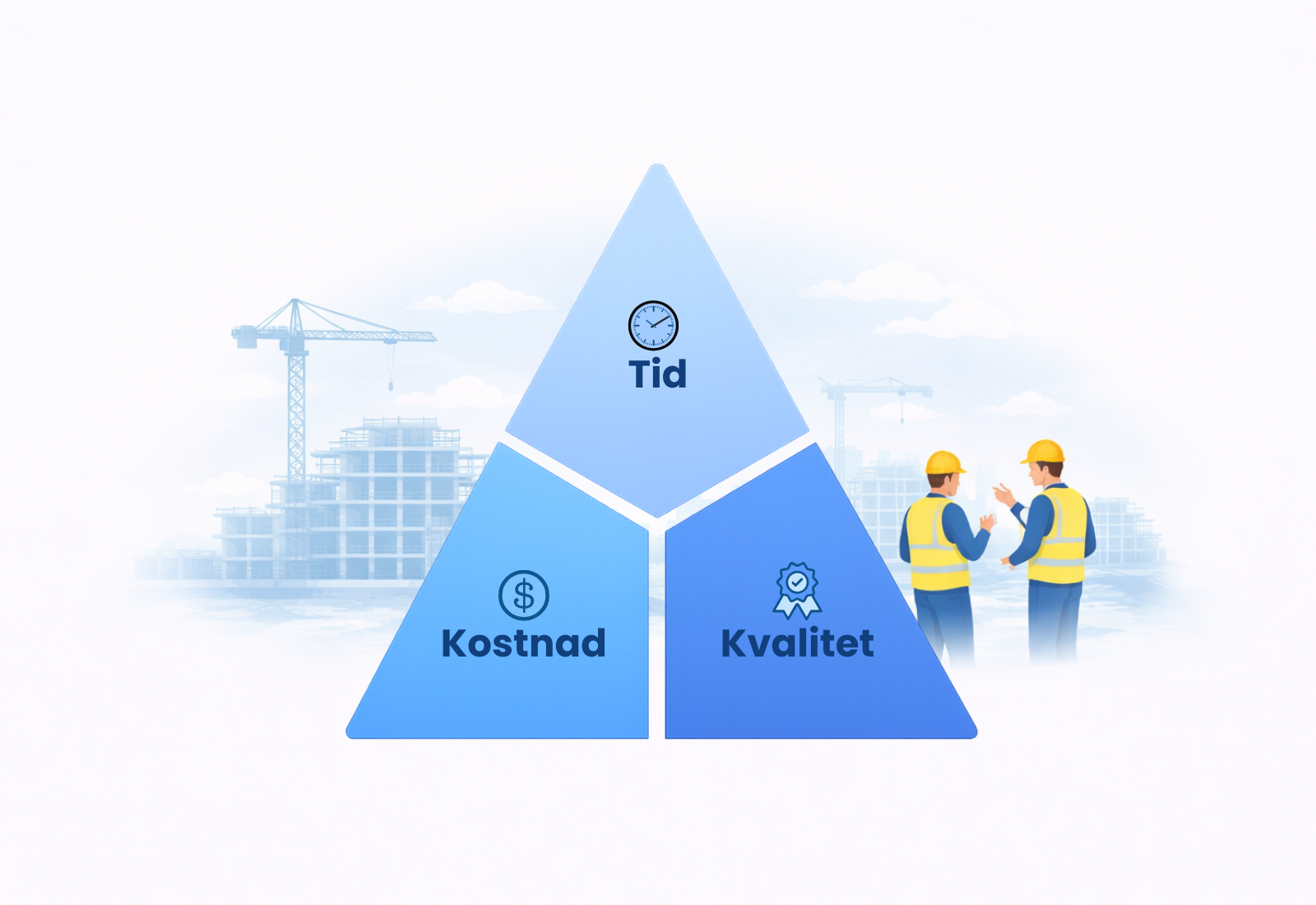
In construction projects, choices must constantly be made between time, cost and quality.
Yet these are often treated as separate objectives – leading to delays, cost overruns and quality deviations.
But what does this mean in practice – and how does it affect the decisions you make in the project?
The project triangle shows how these factors are related, and why changes in one always affect the others.
👉 Read more in our complete guide to project management in construction
What is the project triangle?
The project triangle describes the relationship between three fundamental factors in a project:
Time – how quickly the project will be completed
Cost – what resources and budget are available
Quality – the level of what is delivered
These three are interrelated – and it is not possible to optimize all of them at the same time.
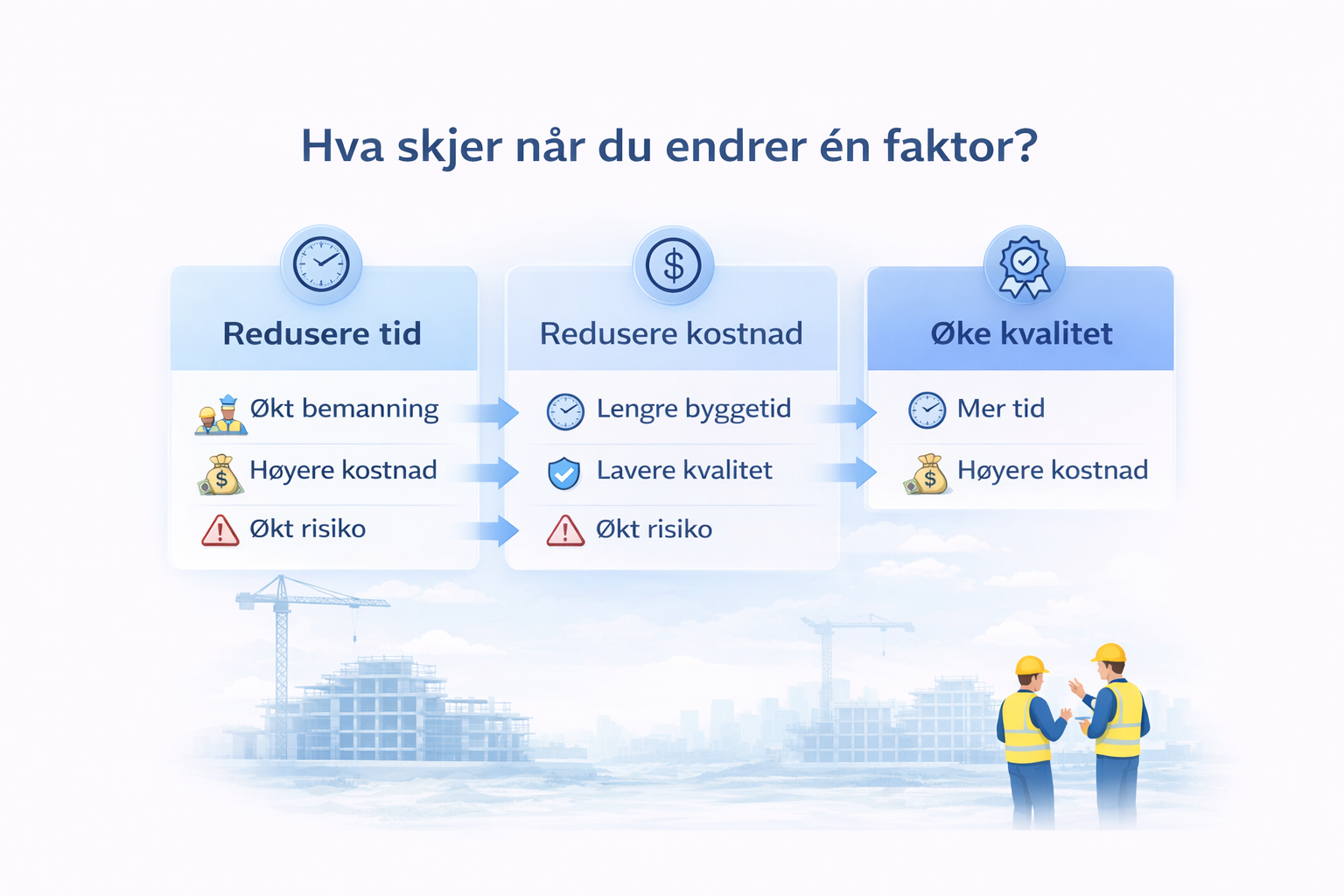
How time, cost and quality are related
The project triangle is not about theory – but about choices.
If you want to reduce time
You need to increase staffing or pace.
→ higher costsOr cut corners
→ lower quality and higher risk
If you want to reduce cost
You need to spend more time
→ longer construction timeOr reduce quality
→ increased risk of errors and deficiencies
If you want to increase quality
You need to spend more time
→ more thorough executionAnd/or increase cost
→ better resources and control
You can't have everything at once. You have to prioritize.
How this works out in practice
In construction projects we see this every day:
Tight deadlines lead to increased staffing or overtime
Pressure on costs leads to less control and more errors
High quality requirements require more time for planning and execution
In a typical construction project with a tight schedule, extra crews are often deployed to meet the deadline.
The result is higher costs, and in many cases more coordination challenges, which in turn affects quality.
When the connection is not clear, it often occurs:
delays
cost overruns
quality deviation
👉 Read more: Project economics in construction
The project triangle and risk
When one corner is pushed, the risk in the project increases.
Example:
shorter construction time → higher risk of errors
lower cost → higher risk of defects
higher quality → risk of delays
The project triangle is therefore also about risk management.
👉 Read more: Risk and uncertainty in construction projects
Common mistakes in using the project triangle
Many projects fail not because the model is wrong –
but because it is not used consciously.
Typical errors are:
try to optimize time, cost and quality at the same time
setting unrealistic deadlines
underestimate the consequences of changes
not linking decisions to actual capacity and risk
The result is often poorer control and lower profitability.
How to use the project triangle correctly
The project triangle is a tool for decision-making.
It should be used to:
consider consequences before making changes
create realistic expectations
Prioritize correctly between time, cost and quality
manage the project more actively
When everyone in the project understands the context, it becomes easier to make the right choices along the way.
The connection with progress and project management
The project triangle is closely related to how the project is actually managed.
The progress schedule affects time
Project economics affect cost
Quality assurance (QA) affects quality
When these are not connected, the project loses control.
👉 Read more: Progress plan in construction and civil engineering
👉 Read more: Quality assurance (QA) in construction
In summary: You need to prioritize
The project triangle shows a simple but important truth:
You can't optimize time, cost and quality at the same time
Every choice has a consequence.
Better decisions lead to better projects
Good project management is not about getting everything done –
but about understanding what you are opting out of.
