
What is an enterprise system in construction – and why is it important according to SAK?
A business system in construction is the foundation for how companies ensure quality, comply with regulations and document their work.
Yet the term is often unclear – and is often confused with ERP systems and software.
In the construction regulations, the enterprise system has a precise meaning that is crucial for liability, supervision and control.
What is meant by enterprise system in construction?
In construction, the enterprise system is the collection of the enterprise's routines for quality assurance, with associated tools.
The system should:
be relevant to the company's tasks
be structured and retrievable
be rooted in management
This is not an IT requirement, but a management requirement.
How is the enterprise system defined in the construction regulations (SAK10)?
Guidance from the Directorate for Building Quality describes the enterprise system as a structure of routines and associated tools that ensure quality in the enterprise's work. The system should make it possible to document how the enterprise meets the requirements of the building regulations.
The enterprise system shall, among other things:
consist of routines
have associated aids
be structured so that content can be retrieved
Supervision and control assess whether the system exists, is used and functions in practice.
The requirement follows from the construction regulations SAK10, which require companies with liability rights to have a system that ensures quality in design and execution.
Enterprise system is not ERP – an important clarification of terms
A common misconception is that enterprise resource planning = ERP.
That's wrong.
Business systems are about routines, responsibility and control.
ERP system is a digital tool that can support these routines
A digital system alone does not meet the requirements without functioning routines.
👉 Read more: Enterprise system ≠ ERP – what is the difference in construction?
Why the enterprise system is crucial for quality, control and reliability
A good enterprise system:
reduces the risk of errors and defects
ensures compliance with regulations
provides better control and predictability
strengthens the company's credibility
It is the foundation for all professional operations in construction.
Corporate system and liability law – what does the municipality consider in practice?
When applying for liability rights and during supervision, the following are considered, among other things:
whether routines are documented
whether they are adapted to the company's role
whether the quality assurance carried out can be documented
The corporate system is therefore directly linked to the right of the enterprise to assume responsibility.
What must an enterprise system contain to meet the requirements?
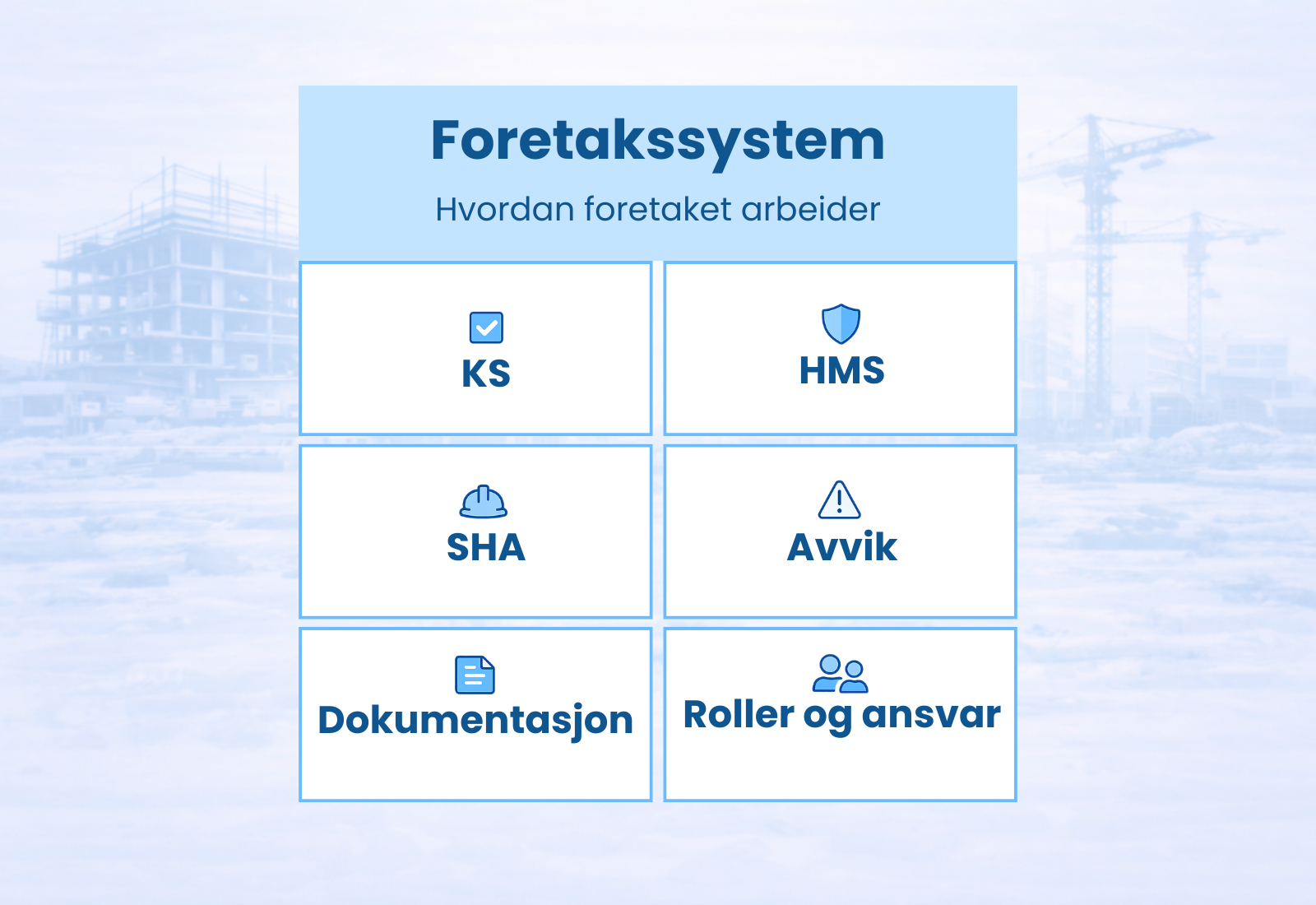
The scope is adapted to the size of the enterprise, but should at least cover:
roles and responsibilities
quality assurance procedures
HSE procedures
deviation management
document management and traceability
Many companies choose to collect routines, responsibilities, expertise and documentation into one system for the company, so that management becomes holistic and easier to maintain over time.
👉 See how a digital enterprise system can collect routines and documentation
How the enterprise system manages projects in practice
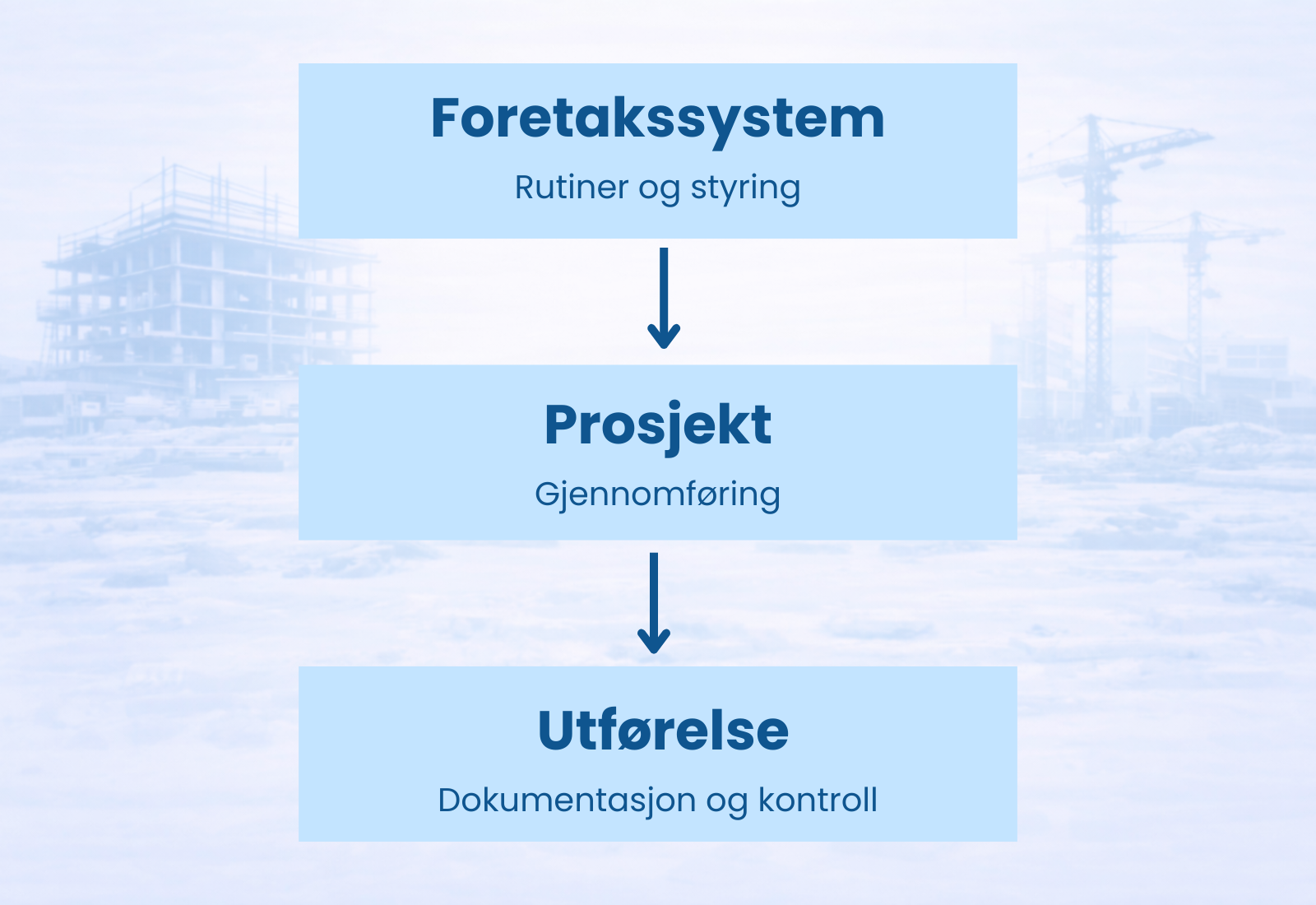
The enterprise system serves as a management framework for the projects:
the company defines the standards
the project follows them
the field documents the execution
👉 For a comprehensive overview of how projects are managed in construction, see also:
Project management in construction – complete guide
Corporate system, KS, HSE and SHA – this is how it all works
HSE (health, environment and safety) is about safety and working conditions in the business over time.
👉 Read more: HSE plan in construction
SHA (safety, health and working environment) applies to safety in the individual project, and follows the requirements of the building owner regulations.
👉 Read more: SHA plan in construction
QA (quality assurance) is about ensuring that the work meets requirements, drawings and specifications.
👉 Read more: KS in construction
These are not separate systems, but parts of the enterprise system.
The enterprise system describes how the company works with quality, safety and control, while KS, HSE and SHA show how this is implemented in practice.
👉 See also: The difference between HSE and SHA in construction
Enterprise system for small enterprises and ENK – what is the minimum that is sufficient?
Small businesses can have simple systems, as long as:
the procedures cover the company's responsibilities
the system is used in practice
documentation can be presented if necessary
It's function that counts – not scope.
Digital tools to support the enterprise system
Digital solutions can:
simplify documentation
ensure traceability
make compliance easier
But they do not replace the company's responsibilities and routines.
How to keep the enterprise system alive over time
An enterprise system must be maintained through:
regular audit
updating of routines
learning from deviations
improvement over time
This makes the system robust and future-proof.
Frequently asked questions about enterprise systems in construction
-
An enterprise system is the enterprise's overall routines, responsibilities and tools for ensuring quality, complying with regulations and documenting work in construction projects.
-
No. The enterprise system consists primarily of routines and management. Digital systems can support the system, but do not meet the requirements on their own.
-
Yes. Companies seeking liability rights under the Construction Act Regulations (SAK10) must be able to document a functioning company system.
Summary: the enterprise system as a bridge between management and implementation
The enterprise system:
sets the standard for how the company works
controls how the projects are implemented
ensures documentation from the construction site and project
A good enterprise system in construction makes it easier to manage projects, document work and meet the requirements of building regulations.