
In construction projects, project management is not just about progress and technical implementation. Equally important is control over the project's finances.
Material costs, labor, changes along the way, and coordination between disciplines can all affect the project's finances. Even small deviations can have major consequences if not detected early.
Therefore, project economics is a central part of good project management in construction.
👉 Read more in our complete guide to project management in construction.
When costs are followed up continuously throughout the project, it becomes easier to detect deviations early, make the right decisions and ensure profitable implementation.
This article explains what project finance involves, why financial control is important in construction projects, and how costs can be followed up in a structured way.
What is project economics in construction projects?
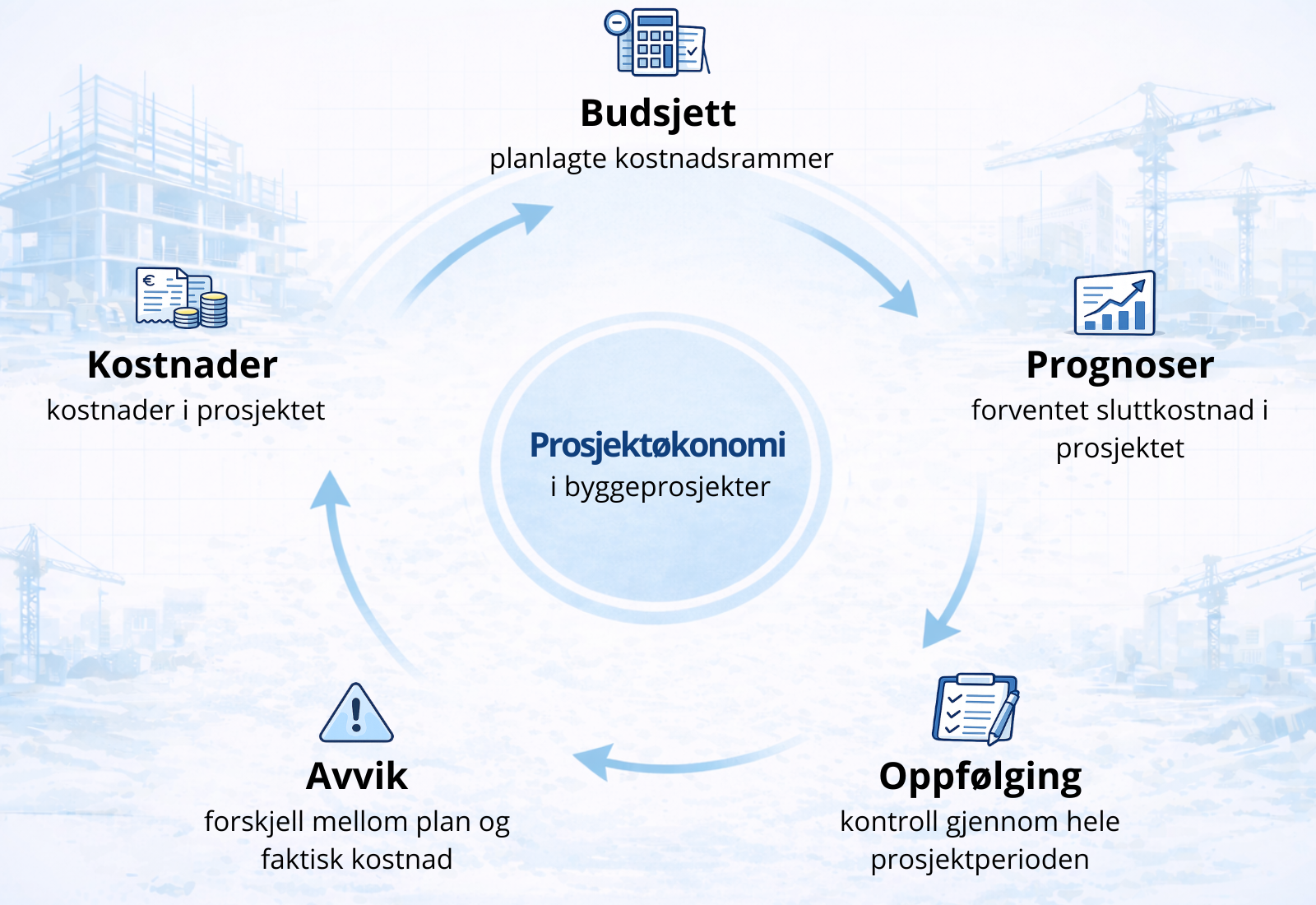
Project economics is about planning, following up and controlling project costs throughout the entire project period.
In a construction project, this includes:
budget and cost limits
monitoring of actual costs
handling of changes and additions
forecasts for the final cost of the project
The goal is to ensure that the project is implemented within the agreed financial framework.
Good project finance provides an overview of how the project is developing financially, and makes it possible to detect deviations before they become major problems.
Why financial control is demanding in construction projects
Construction projects are complex and involve many actors, deliverables and activities, making financial management more demanding than in many other types of projects.
Some of the most common challenges are:
Many suppliers and contractors
Changes to the project along the way
Uncertainty related to progress
Coordination between several disciplines
Costs incurred in the field
When financial information is not updated continuously, the project may lose track of the actual cost situation.
The result may be that financial discrepancies are only discovered late in the project.
What affects the project's finances?
Several factors can affect the economics of a construction project.
Among the most important are:
Material costs
Resource usage and working hours
Project progress
Changes and additions
Unforeseen circumstances
When these factors are not followed up systematically, the cost picture can quickly change.
Therefore, project finance is closely linked to other parts of project management, such as progress, changes, and risk.
👉 Also read the article about change management in construction.
Typical cost items in construction projects:
Typical cost items in construction projects can be linked to several different parts of the implementation. Some of the most common cost items are:
material costs
subcontractors
engineering
rigging and operation
machinery and equipment
transport and logistics
waste management
winter measures
When the project has an overview of such cost items, it also becomes easier to follow up on the project's finances along the way.
How project economics is followed up in practice
In construction projects, project finances are usually monitored through a structured process.
This includes, among other things:
Budget and cost framework
The project starts with a budget that defines expected costs for different parts of the project.
Recording of costs
Throughout the project, actual costs related to work, materials and deliveries are recorded.
Comparison against budget
The project's actual costs are continuously compared with the budget.
This makes it possible to identify deviations early.
Final cost forecasts
Based on the project's development, one can estimate what the total cost will be when the project is completed.
This provides a better basis for decisions along the way.
A simple method for better project economics in construction projects
To ensure good control over project finances, many construction projects follow a structured follow-up process throughout the project period.
A simple method can be described in five steps:
1. Establish a clear budget
The project starts with a cost framework and a detailed budget for the different parts of the project.
This provides the basis for financial follow-up throughout the project.
2. Record costs on an ongoing basis
Actual costs related to work, materials and deliveries should be recorded continuously.
The earlier costs are recorded, the easier it is to detect discrepancies.
3. Compare budget and actual cost
The project should regularly compare planned costs with actual costs.
This makes it possible to identify financial discrepancies before they become large.
4. Update forecasts
Based on the development of the project, the forecast for final cost should be updated continuously.
This provides a better basis for decisions along the way.
5. Follow up on deviations and changes
If costs deviate from the budget, the cause must be analyzed and measures considered.
Changes to the project must also be assessed financially and clearly documented.
The connection between progress, changes and project economics
Project economics is closely linked to other parts of project management.
Changes to the project can directly affect costs.
Similarly, delays in progress can lead to increased costs.
Therefore, financial follow-up is closely linked to progress management, risk and coordination between disciplines.
👉 Read more about how uncertainty and risk can affect construction projects in our article about risk and uncertainty in construction projects.
When the project has a good overview of progress, risks and changes, it also becomes easier to keep control of the finances.
Common challenges in project finance
Even in well-planned projects, challenges related to financial management often arise.
Some of the most common are:
costs are recorded too late
lack of overview of changes
Financial follow-up happens too rarely
forecasts are not updated along the way
financial information is spread across multiple systems
When finances are not monitored continuously, it becomes difficult to make good decisions in the project, and financial discrepancies can occur.
👉 Read more in the article about non-conformance management in construction.
Real-time overview in project finance
In many construction projects, financial challenges arise because information about costs, progress, and changes is updated too late.
When financial information is recorded and updated continuously in the project, it becomes easier to detect deviations early and make the right decisions along the way.
Real-time overview of the project's finances can, among other things, make it possible to:
follow the development of costs continuously
see the connection between progress and economy
detect deviations earlier in the project
update forecasts faster
When project finances, progress, changes and documentation are collected in the same structure, the project gets a better overview of the actual financial situation throughout the project period.
Many businesses therefore choose project management systems that make it possible to combine finances, progress, and changes in one solution.
In summary
Project finance in construction is an important part of the management of construction projects. When costs are systematically followed up through budgeting, cost registration and updated forecasts, the project gets a better overview of the financial development.
Good financial control makes it possible to detect deviations earlier, handle changes more structuredly and make better decisions throughout the project.
When the project has clear routines for following up on costs, it also becomes easier to ensure that the project is carried out within the agreed financial framework.
