
How HSE, KS, SHA and project management are interconnected in construction

The construction industry is full of terms: HSE, KS, SHA, SJA, non-conformities, internal control and project management.
Together, these systems will ensure quality, safety and control in construction projects.
Most people in the industry know the words. Fewer see the big picture.
In many businesses, everything is available – but each in its own structure:
HSE in one binder
KS in another folder
The SHA plan in the project folder
Email discrepancies
The progress schedule in Excel
Everything exists. But little is connected.
When systems do not reflect how work is actually carried out, what many experience as system chaos occurs.
Briefly explained:
HSE is about the company's work with health, environment and safety over time.
KS is about quality assurance of the work.
SHA is about safety, health and the working environment in each project.
Project management is about planning, implementing and following up on construction projects.
These systems complement each other and together form the structure for how construction projects are managed in practice.
This article explains how HSE, KS, SHA and project management are actually interconnected in construction – and why the whole is crucial for good management.
1. Why many people experience system chaos in construction projects
Most construction companies already have many of the systems they need.
The problem is rarely that something is missing. The problem is that the systems live separately.
For example, it might look like this:
HSE is handled in one solution
KS documents are in Word or in a folder
The SHA plan is located in the project folder.
The progress plan is in Excel.
Deviations are registered via email.
Each part works in isolation. But when the information is not connected, it becomes difficult to get an overview.
The consequences are often the same:
documentation is only collected upon handover
deviations are registered too late
responsibility becomes unclear
Audits are perceived as stressful
The systems exist – but they do not reflect how the work is actually carried out in the projects.
2. Laws and regulations – the basis for governance
The reason why construction projects have many systems is that the industry is regulated by several laws and regulations.
Among the most important are:
The Working Environment Act (AML)
Internal Control Regulations
The Building Owners' Regulations
Planning and Building Act (PBL) with SAK10
These require, among other things:
systematic HSE work
project-specific SHA plan
documented quality assurance
traceability and compliance
HSE, KS and SHA are therefore not separate or optional systems. They are different mechanisms for fulfilling statutory requirements.
3. Internal control and corporate system – the structure of the business
At the enterprise level, the requirements are organized through internal control and enterprise systems .
This describes, among other things:
routines and procedures
roles and responsibilities
training and expertise
deviation management
documentation and traceability
This applies to the entire business – not just one project.
The enterprise system defines how the business is to be managed, and what requirements apply to the projects.
👉 Read more in the article:
What is an enterprise system in construction – and why is it important?
👉 Many people confuse enterprise systems with digital tools – read more: Enterprise systems ≠ ERP – what is the difference in construction?
4. KS and SHA – the project's control mechanisms
When a construction project begins, the company's routines must be translated into practical project management.
This is where KS and SHA come into play.
KS (quality assurance) is about ensuring that the work is carried out in accordance with:
contracts
drawings and descriptions
technical requirements
internal procedures
SHA (safety, health and working environment) is about risk management in the specific project.
Simplified context:
HSE – the company's system for health, environment and safety over time
SHA – safety and working environment in the individual project
KS – quality assurance and documentation of the work
👉 Read more in the articles:
5. Project management – where everything meets
Project management is the framework that brings together all of these elements.
In a construction project, project management is about, among other things:
progress
resource use
documentation
changes
deviation
cooperation between actors
This is where HSE, KS and SHA must function in practice – not just in documents.
When project management is fragmented, typical challenges arise:
Deviations are recorded, but not followed up
risk assessments are carried out once and forgotten
documentation is only collected upon handover
responsibility becomes unclear
Many of these challenges arise when project management is not integrated into daily work.
👉 Read more in the article: Project management in practice in construction
For a comprehensive review of project management, see also:
Project management in construction – complete guide
6. Field execution – where the documentation occurs
Although many systems are established in the office, the most important documentation occurs in the field.
This is where the work is actually done.
Typical documentation in the field is:
SJA (safe job analysis)
checklists and self-control
pictures from the execution
registration of deviations
inspections and follow-up
When documentation is recorded at the same time as the work is carried out, quality assurance becomes part of the process – not an afterthought.
7. Learning and improvement
Project work does not stop upon handover.
Experiences from projects must also be fed back into the business.
The following, among other things, play an important role here:
deviation analysis
revisions
experience transfer
updating of routines
When learning is linked back to internal control, the business can improve both processes and quality over time.
8. The simple model – six levels
To understand the whole picture, management in construction can be described as six levels:
1. Laws and regulations
Sets the requirements for how work should be performed.
2. Internal control
Describes how the business complies with the requirements.
3. Enterprise system
Defines routines, responsibilities and management structure.
4. Project
Planning and implementation of the individual project.
5. Execution
Work and documentation in the field.
6. Learning and improvement
Experience from projects is used to improve the system.
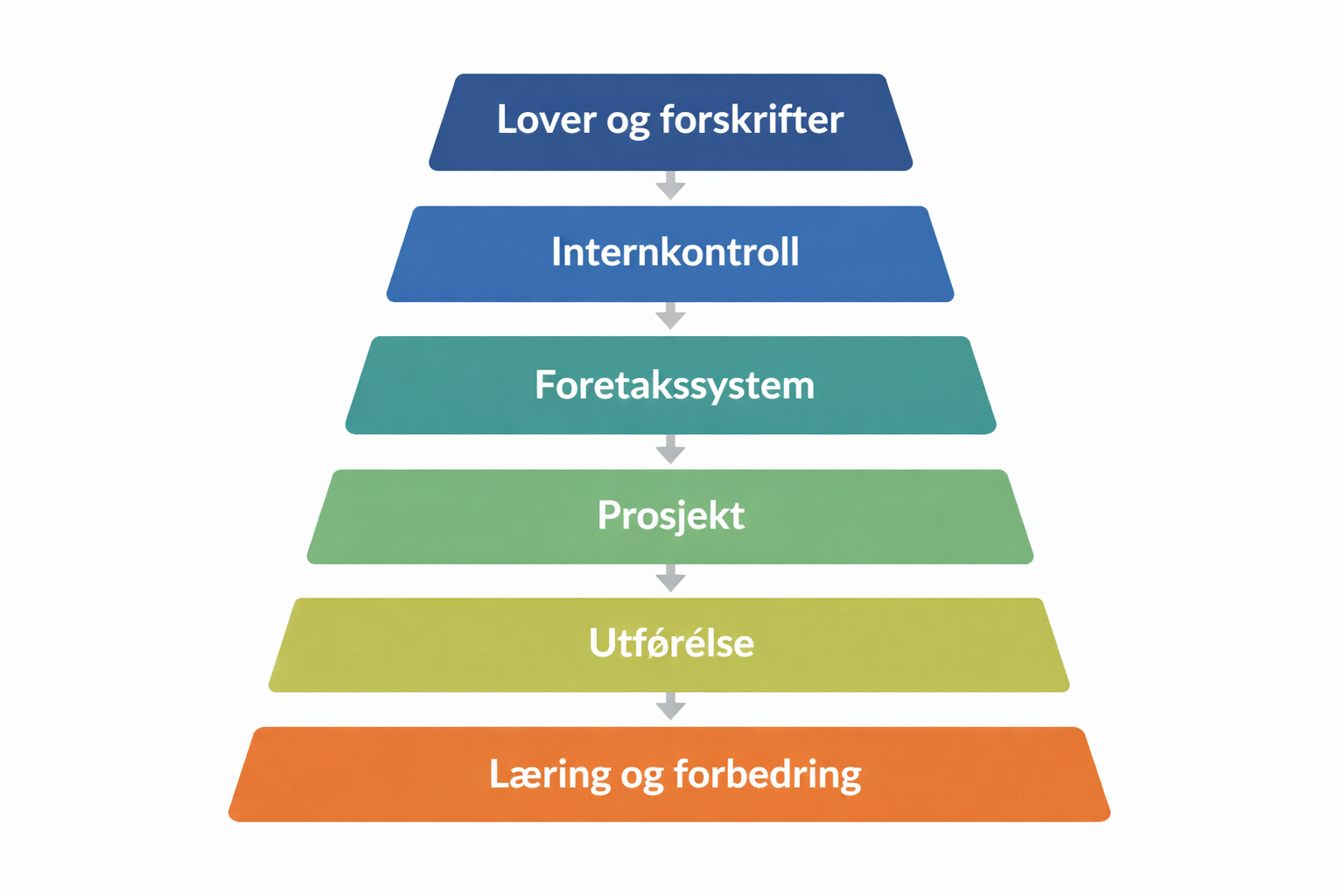
Each level builds on the previous one.
When all levels are interconnected, control occurs.
When the levels live separately, system chaos occurs.
In summary
HSE ensures safe operations in the business over time.
SHA ensures safe implementation of the project.
KS ensures professional quality and documentation.
Project management ties everything together in the daily implementation.
When HSE, KS, SHA and project management are viewed in context, the business gains better control over both safety, quality and progress.
Without this whole, system chaos easily arises – even if all the systems actually exist.
In larger and more complex projects, it is becoming increasingly difficult to keep this whole thing together manually. That is why many companies choose to combine HSE, KS, SHA and project management into one structure – so that the systems actually reflect how the work is carried out in practice.
